+86-15221358017 / 15221358018 /15221358066/13916032681 info@purilaser.com

Views: 9 Author: Site Editor Publish Time: 2026-07-22 Origin: Site


I've lost count of how many times someone has told me,
"My laser isn't cutting anymore. I think the tube is dead."
Funny thing is...quite often, the tube isn't the real problem.
After working with CO₂ laser equipment for well over a decade, I've learned one lesson that keeps repeating itself:
A weak cut doesn't always mean a bad CO₂ laser tube.
Sometimes it's dirty mirrors.
Sometimes the power supply.
Sometimes cooling water that's just a little too warm.
And sometimes...yes, the laser tube has simply reached the end of its working life.
So how do you actually know?
Let's go through the signs I'd check before ordering another CO₂ laser tube.
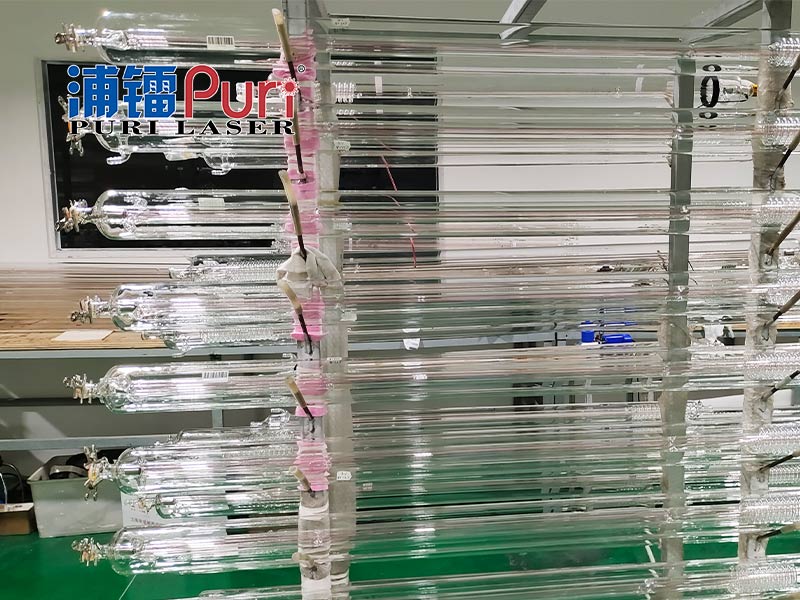
This is probably the question we hear most.
There isn't one universal answer.
Different manufacturers use different glass, gas mixtures, catalysts, mirror alignment methods and sealing technology. Two laser tubes with the same rated power can have very different service lives.
For most standard glass CO₂ laser tubes on today's market:
Tube Quality
Typical Working Life
Entry-level | 2,000–4,000 hours |
Standard industrial | 5,000–8,000 hours |
High-quality CO₂ laser tube | Around 10,000 hours |
At Puri Laser, our engineering team focuses on extending gas stability instead of simply chasing higher initial power. Through catalyst coating technology, precision mirror alignment, controlled gas filling and strict sealing processes, the average chemical service life of our CO₂ laser tubes reaches approximately 10,000 working hours under recommended operating conditions.
Notice I said chemical service life.
That doesn't mean the tube suddenly stops at 10,001 hours. Output power simply declines gradually.
And that's exactly what most users notice first.
One day your machine cuts 6 mm acrylic with no problem.
A month later...
Same material.
Same settings.
Now you need to slow the speed by 20%.
A few weeks later...
Maybe 30%.
Nothing else changed.
This slow loss of performance is one of the clearest signs that a CO₂ laser tube is aging.
The gas inside the tube isn't "running out." That's a common misunderstanding.
Instead, years of electrical discharge slowly change the gas composition. The tube still produces a laser beam, just not as efficiently as before.
Here's something I've seen many operators do.
Machine starts feeling weaker.
They raise laser power from 60% to 70%.
Then 80%.
Then 90%.
Eventually they're running at nearly 100% all day.
If your production settings keep creeping upward just to maintain the same cutting quality, your CO₂ laser tube is probably losing output power.
Running continuously at maximum power usually speeds up aging even more.
This confuses many beginners.
Engraving still looks clean.
Photos come out nicely.
Text is sharp.
But cutting suddenly struggles.
Why?
Because engraving needs far less energy than full-depth cutting.
A CO₂ laser tube can lose a noticeable amount of power before engraving quality starts to suffer.
When customers describe this exact situation, the laser tube immediately moves higher on my inspection list.
Power loss isn't always obvious.
Sometimes the problem is stability.
You might notice:
One sheet cuts perfectly.
The next doesn't.
Corners burn unexpectedly.
Some areas don't cut through.
If mirrors are aligned, lenses are clean and the power supply is stable, inconsistent beam output often points toward an aging CO₂ laser tube.
Every laser tube has a recommended operating current.
Let's say an 80W tube normally performs well around 24–26 mA.
Months later you find yourself pushing 28 or even 30 mA just to get acceptable cutting.
That's usually not a good sign.
Higher current doesn't restore the tube.
It only accelerates wear.
Think of it like driving a car with the accelerator fully pressed because the engine has lost compression.
It still moves.
Just not efficiently.
Sometimes troubleshooting becomes a process of elimination.
Cooling water?
Normal.
Water temperature?
Around 20–25°C.
Mirror alignment?
Correct.
Lens?
Clean.
Power supply?
Stable.
Machine mechanics?
No issues.
Yet output remains weak.
At this point, replacing the CO₂ laser tube becomes the most logical next step.
Not every failure is dramatic.
Most laser tubes age quietly.
We've worked with furniture factories that run two shifts every day.
Textile customers cutting fabric almost around the clock.
Sign makers processing acrylic week after week.
After several years, performance naturally declines.
No surprise there.
Laser tubes are consumable components.
The goal isn't making them last forever.
It's getting predictable, stable performance throughout their service life.
One customer from South America contacted us after replacing mirrors twice and installing a new power supply.
The machine still couldn't cut 10 mm acrylic cleanly.
They were convinced something else had failed.
We asked one question.
"How many hours has the current CO₂ laser tube been running?"
The answer?
Almost 8,500 hours.
After replacing it with a Puri Laser CO₂ laser tube, cutting speed increased by roughly 30% under similar production conditions, while edge quality became noticeably cleaner. No machine modifications were needed.
That's actually a common story.
Many users spend days chasing mechanical problems when the laser tube has simply reached the end of its useful life.
Definitely.
No maintenance can stop aging completely, but good operating habits make a big difference.
Here's what I usually recommend:
Keep cooling water between 18–25°C.
Never exceed the recommended operating current.
Clean mirrors and focusing lenses regularly.
Maintain accurate beam alignment.
Avoid frequent power cycling during production.
Keep the cooling system free from contamination.
Choose a reliable CO₂ laser tube factory that uses consistent gas filling and quality control from the beginning.
A well-built tube almost always outperforms a cheaper one over the long run.
A CO₂ laser tube rarely fails overnight.
More often, it gives small warnings.
Cutting gets slower.
Power settings keep increasing.
Production becomes less consistent.
These changes are easy to overlook if you're busy running jobs every day.
If your machine has already eliminated issues with optics, cooling and power supply, the laser tube deserves a closer look.
At Puri Laser, we've spent years manufacturing CO₂ laser tubes for engraving, cutting and industrial processing equipment. Every tube goes through precision mirror alignment, controlled gas filling, catalyst coating and output testing before shipment. The result isn't just higher initial power—it’s stable performance over time, with an average chemical service life of around 10,000 working hours under recommended operating conditions.
From an engineer's perspective, replacing a worn CO₂ laser tube at the right time often saves far more in lost production than trying to squeeze out a few extra months.
Sometimes the simplest answer really is the correct one.